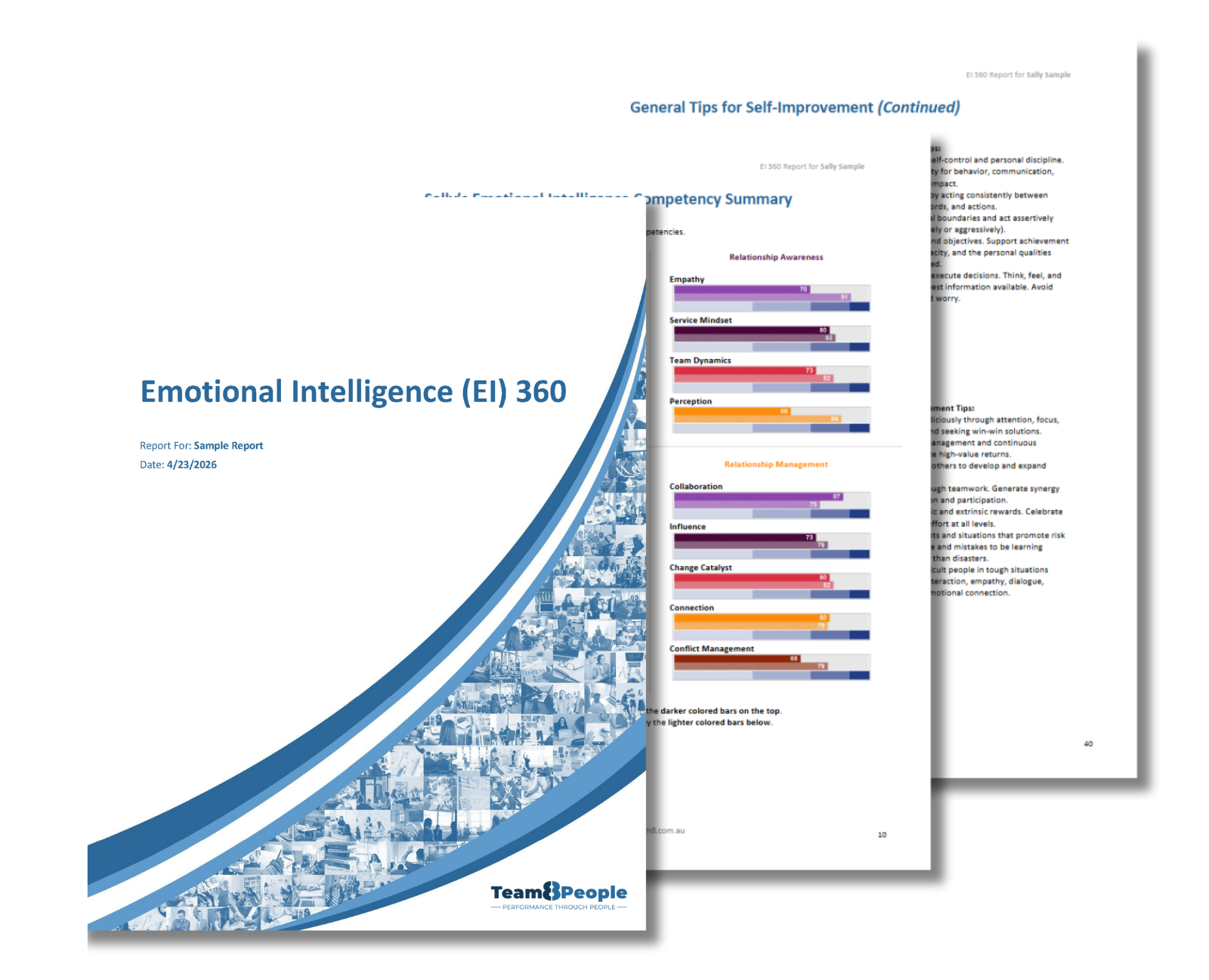
Emotional Intelligence 360 Assessment
(EI-360)

There is Only One Way to Truly Measure EI.

Combining self-perception with structured feedback from the people around you.

Why Emotional Intelligence Matters

Performance is emotional. The emotional regulation of a leader or coach shapes the engagement and performance of everyone around them, and most importantly EI is competency-based, meaning it can be measured, developed, and improved.

Performance is Emotional

Whether it is an athlete on the starting line of an Olympic final, a coach on a sideline, or a leader in a board meeting, the difference between a great practice and a great performance is emotional management in the moment that matters.

The Leader Sets the Tone

Goleman determined that roughly 70% of the climate inside teams and organizations is set by the emotional tone of the leader. A leader who cannot regulate their own emotions is, by default, shaping the engagement and performance of everyone around them.

EI Can Be Developed

Unlike behavioral style, which describes preference, emotional intelligence is competency-based. It can be measurably improved with the right interventions, which is exactly why measuring it, with both self and observer perception, matters.

What Does the EI-360 Measure?

Four elements, 18 competencies, two perspectives.

Self-Awareness

Recognizing what you are feeling.

Understanding what is driving it, and appreciating the impact on your behavior and the people around you.

Self-Management

Regulating your emotions.

Noticing a trigger, choosing a different response, and creating the state that best serves the moment, the team, and the outcome.

Relationship Awareness

Reading the room.

Picking up the emotional cues of others, sensing tension or disengagement, and understanding why someone might feel the way they do. Empathy anchors this quadrant.

Relationship Management

Handling conflict, influencing well, and building rapport across different styles.

High scorers connect effectively with almost anyone, regardless of how similar or different they are.

Why Use 360-Degree Feedback?

The way we believe we are showing up does not always match how others actually experience us. Self-perception is biased by design. For most EI competencies, that gap is the single most valuable piece of data we can collect. The 360 design surfaces those perception gaps and turns them into a targeted development plan.

1

Self Perception

The way we believe we are showing up does not always match how others actually experience us.

Self-perception is biased by design.

2

Observer Perception

In order to get a comprehensive understanding of EI we need to obtain how those close to us perceive our EI capabilities in addition to our own perceptions.

3

Perception Gap Revealed

For most EI competencies, any perception gap revealed is the single most valuable piece of data we can collect. The 360 design surfaces those perception gaps and turns them into a targeted development plan.

4

Targeted Development Plan

Once the perception gap is revealed, users are able to see their potential areas of improvement, from here a targeted development plan is put in place to help close those gaps and improve Emotional Intelligence.

Who is the EI-360 for?

T8P EI-360 Report

How the EI-360 Pairs with DISC

DISC

DISC Builds Self-Awareness,
The foundation for EI

DISC describes the way you naturally prefer to behave, your behavioral operating system and builds the self-awareness foundation for developing Emotional Intelligence.

EI-360

How others experience your Emotional Intelligence

The EI-360 measures whether, when, and how you flex behavior in response to the people or situation in front of you. The 360 component means we don’t rely on only our self-perception of our interactions, but actually gain insight into how others experience them.

Self-awareness is the foundation. Relationship management is structurally impossible without it, which is why the EI-360 is most powerful when sequenced after DISC.

Become Accredited in DISC & EI

How to Access

Purchase with Team8 People Support

Buy assessments directly, with optional individual or group coaching to debrief results and design a development plan.

Best for organizations, leadership cohorts, and individual leaders.

Become EI Accredited

Get Accredited and deliver the EI-360 inside your own practice. You can pair this with our DISC Accreditation at a reduced combined price, or become accredited in EI as a stand-alone tool.

Existing Team8 People accredited DISC consultants are onboarded into EI at no additional accreditation cost.

Emotional Intelligence 360 FAQs

What is the Emotional Intelligence 360 Assessment?

The Team8 People Emotional Intelligence 360 (EI-360) Assessment is a structured measurement tool that captures both self-perception and observer feedback across the four elements of emotional intelligence and the 18 underlying competencies.

The four elements of emotional intelligence are:

  • Self-awareness
  • Self-management
  • Relationship awareness
  • Relationship management


The 360 design is essential because self-perception alone is often biased; observer feedback is the only reliable way to truly measure how emotional intelligence shows up in practice.

Emotional intelligence is fundamentally about how we manage ourselves and others, and how we are perceived and how our emotions affect others. Self-rating alone produces blind spots, especially in self-awareness. By layering observer feedback over self-perception, the EI-360 reveals the perception gaps - the differences between how you see yourself and how others experience you, that pinpoint the most valuable areas for growth.

DISC describes preferred behaviors, your natural operating system. Emotional intelligence determines whether, when, and how you flex that operating system in any given moment. DISC builds the foundation of self-awareness, which is the first quadrant of EI. We typically recommend DISC first, followed by the EI-360 as the next stage of development. We never start with EI; DISC builds the language and self-awareness that makes the EI conversation more powerful.

The assessment suits leaders, executives, managers, frontline supervisors stepping into senior roles, coaching, athletic administration, HR and people-and-culture professionals, athlete leaders and captains, and emerging leaders within high-performing teams. It is most powerful as the second stage of a leadership development pathway, after DISC has built the behavioral foundation.

There are two pathways. The first is to purchase assessments directly, with optional individual or group coaching delivered by Team8 People facilitators. The second is to become accredited to deliver the assessment yourself, either as a stand-alone EI Accreditation or complete our DISC + EI combined Accreditation Program at a significantly reduced combined price. For existing Team8 DISC consultants we offer EI Accreditation at no additional accreditation cost, with a minimum 20 assessment commitment.

The four elements are: self-awareness (recognizing your own emotions and their impact), self-management (regulating those emotions and choosing more useful responses), relationship awareness (reading the emotional cues of others, anchored by empathy), and relationship management (handling conflict, influencing well, and building rapport across different styles).

Empathy is the capacity to recognize emotions in others and appreciate why they might be feeling that way. It is the critical competency that anchors relationship awareness and relationship management. Across studies of effective leadership, empathy consistently appears among the small set of non-negotiable competencies. Without it, relationship awareness is structurally impossible.

Yes. Unlike DISC, which describes preference, emotional intelligence is a competency-based model. With the right interventions, including labeling emotions, modeling others who do a competency well, deliberate practice, recovery strategies, and feedback, EI can be measurably improved over time. That is the entire premise of measuring it.

The EI-360 price will be on-par with the cost of our DISC Profile Assessments (US$99.95 per assessment, self-managed and report only). Benefit from a proven and high-quality tool that is substantially below the typical $200–$400 range for EI assessments on the market. We massively believe in the tool and that the cost should not become a barrier to development.